Total Pageviews

Thursday, May 17, 2012

Coryanthes macrantha - Bucket Orchid


The Genus Coryanthes belongs to Stanhopeinae and bears some of the most bizarre and intricate flowers in nature. There are about 60 species for this genus. They are pollinated by male orchid bees which collect fragrant substances which are said to be important for their mating.


Coryanthes macrantha is an Orchid from the genus of the Bucket Orchids. It is native to South America and the Amazon and grows as an epiphyte. It ranks amongst the strangest flowers in the whole of the plant kingdom let alone,  the orchids. Whether one would consider it as beautiful or not, it is hard to not be amazed by it. Beauty is in the eyes of the beholder. Even at the bud stage it is clear that it is going to be no ordinary flower. At 80 mm, the flower is also much larger than any image would suggest.

They are shade growers and best exposed to indirect morning sun. They should be cultivated in baskets in a media that does not dry out quickly. Sphagnum moss is commonly used as the potting medium for water retention and acidity. I am using coarse bark top up with sphagnum moss. It is essential to hang the plants as the flower comes out from the side or the bottom of the pot and the long inflorescence. They are able to tolerate our tropical warm temperatures, fairly high humidity with good air circulation. They have fairly thin leaves that are prone to water loss. The plant is given water almost daily to keep them fairly moist.

They love to be fertilized but weakly and weekly at ¼ of the recommended strength. They share the same fertilizing regime as my Paphs.

The bud took about a month (25 days) to develop and “exploded” to complete opening over-night on the 25th day. It has a strong pleasant fragrance that combines antiseptic with spices and floral mint qualities. The plant was obtained a year ago with 2 pseudo bulbs but has since grown to 8 heads varying from 25 to 60 mm.


The above shows the development of the flower from the appearance of the inflorescence to fully exploded flower. The bottom two photos show from bud to  fully exploded overnight

Wednesday, May 16, 2012

OSSEA May 2012 Table Display.

 Here are some of the Paphs that were brought to the Monthly Table Display. There were not many paphs during the show.

Paph godefroyae fma leucochilum:
Two inflorescences with one flower on each inflorescence. Cream colour across the petals and sepal.  Heavy maroon blotch radiating from the centre with cream border on it. Petals marked with finely sprinkled maroon. Clear cream pouch.

Paph godefroyae fma leucochilum:
One flower on a single inflorescence. An uncommon creamy yellow form. Dorsal sepal spotted deep burgundy. Petals marked with burgundy spots around the central two thirds of the petals. Clear ivory pouch. Flower is slightly cupped.


Paph Green Horizon:
A hybrid between Paph Makuli and Paph philippinense. One flower with two buds on  a single inflorescence. Dorsal sepal white, lined with apple green stripes. Slightly arched petals lined with green. Pouch pale green. 
Note: Paph Makuli is a cross between Paph Maudiae x Paph sukhakuli and Paph Maudiae is a cross between Paph callosum and lawrenceanum.
Paph Conliem:
A primary hybrid between Paph liemianum and Paph concolor. It takes the colour of concolor and to a lesser degree the shape of liemianum. An easy to grow hybrid that was grown from very small seedling to a specimen size plant that has about 8 growths in SH.

Paph Chou-Yi Yuki:
A primary hybrid between Paph niveum and paph hangianum. Dorsal sepal and petals white with a tinge of light yellow on it. Purple spots radiating from the staminode toward half of the upper half of the petals. Round and inflated white pouch.
A fairly large and well balanced flower that has takes the  size of Paph hangianum and colour of Paph niveum.


Thursday, May 3, 2012

From Flower to Flower - is it worth doing?


The is the first flower that I made from my own plants. From the time of fertilization to  flower, it took about 5 years to achieve it.  The outcome of the crossing is not outstanding but feels great to see the result.
You can decide whether is it worthwhile to make crossing from your own flowers or should buy ready made flask or seedlings.
I have listed some of my comments below as to why  slipper orchids are expensive and why it make more sense to buy ready made flasks from reputable growers.


Saturday, April 28, 2012

April 2012

Phragmipedium pearcei:
A native  South America  slipper orchid. The plants have grass-like leaves. A relatively easy to grow and heat tolerant than other Phrag which suit our local weather. Once the plant matures, you would have continuous bloom. The plant has about 10 growths and grown in SH (semi hydro).


Add caption

  
Paph Conliem:
A primary hybrid between Paph liemianum and Paph concolor. It takes the colour of concolor and to a lesser degree the shape of liemianum. An easy to grow hybrid that was grown from very small seedling to a specimen size plant that has about 8 growths in SH.

Paph wellesleyanum x Paph armeniacum:
The was grown from flask and bought as an alba hybrid. When it blooms it still has the burgundy spots across the sepal and petals. Small burgundy spots across the the petals and sepal with clear yellow pouch.

Paph godefroyae.

Paph godefroyae fma leucochilum 371-4:
One-Eyed Jack because of the marking on the right half of the dorsal sepal. A well balanced shape between the dorsal and petals. Deep burgundy markings over light cream base.


Paph godefroyae fma leucochilum 184-5:
Well marked tessellations across the dorsal and petals. Deep burgundy marking over light cream base that stretches across the whole flower.
 
Paph godefroyae fma leucochilum 5009-1:
Heavy marking that tapers to smaller markings towards the perimeter of the dorsal and petals. Deep burgundy marking over yellow base.
 
Paph godefroyae fma leucochilum 5009-2:

Dark  burgundy marking over yellow base with clear yellow pouch.  A large flower with a NS of 86 mm across.


Sunday, April 1, 2012

OSSEA April 2012 - Table Display.

Paph godefroyae fma leucochilum TR118-2:
Flower base is cream-colour. Dorsal sepal heavily spotted burgundy, coalesced to to near solid centrally. Petals heavily spotted deep burgundy. Some irregular burgundy spots on the pouch. NS of the flower is 82 mm.


Paph godefroyae fma leucochilum MK436-9:


Sepals and petals are dark cream-colour, dorsal sepal spotted dark burgundy. Petals tessellated with burgundy across the whole petals. Pouch light cream with burgundy spots. The NS of the flower is 80 mm.


Paph Mint Chocolate #2:


A primary hybrid between Paph malipoense and Paph godefroyae. Single inflorescence with 2 flowers. Flower light cream with fine dark brown tessellations radiating from the centre and fading towards the tip. Light cream pouch. The NS of the flower is 100 mm.


Paph niveum:


One slightly cupped, full white flower on a single inflorescence. Very light maroon dusting on both the petals and sepals.


Paph villosum:


Petals have light green base, upper half light brown, mahogany central stripe, lower half flushed with light yellow. Dark mahogany veins radiating from the centre toward the top of the dorsal sepal and white edge at the top.


Paph sukhakulii:


Petals green with heavy n burgundy spots, dorsal sepal white with vertical green stripes. Pouch white to cream base with dark brown veins across the whole pouch.


Michael Koopowitz:


A primary hybrid between Paph philippinense and Paph sanderianum. 2 flowers and 1 bud on a slightly arched inflorescence. Dorsal sepal marked with dark mahogany, light mahogany evenly through the petals.


Paph rothschildianum:


Paph rothschildianum is also know as king of Paphs. Plants are found in Mt Kinabalu at elevation of 600 to 1200 meters. It is also one of the most awarded paphs that every paph growers love to grow. Normally it produces between 2 to 4 flowers.


Two flowers and 1 bud on a well arranged and upright inflorescence. Cream colour sepals with burgundy vertical stripes. Hirsute petals held almost horizontal, cream coloured and dotted burgundy. Cream pouch deeply suffused mahogany.


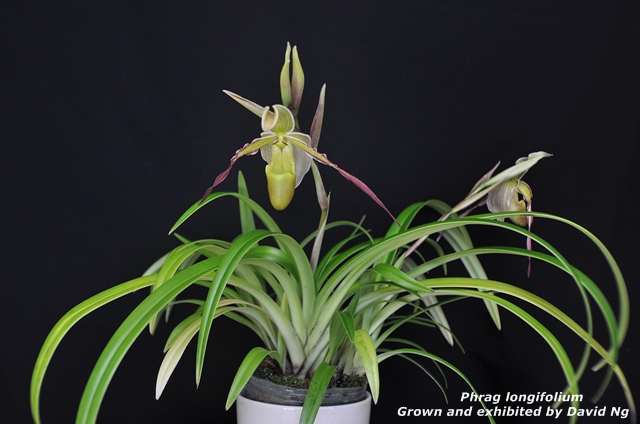
Phrag longifolium:


A nicely grown specimen plant with two flowers from two inflorescence. Dorsal sepal creamy green, evenly veined mahogany. Petals apple green and margins heavy overlaid mahogany.Pouch apple green.


Phrag Haley Decker:


A hybrid between Phrag kovachii and Phrag Saint Quen (P. besseae x P. Hanne Popow). A hybrid that still retains the basic shape of kovachii and this progeny has Phrag besseae and Phrag schlimii in it.
Dorsal sepal and petals purple-colour. Pouch creamy overlaid and veined with purple-colour.


Friday, March 23, 2012

Phragmipedium kovachii


Phragmipedium kovachii was first discovered in Northern Peru in 2001 but was described and published in June 2002. It was named after Michael Kovach. The discovery was considered to a very important for orchid species in the past 100 years.

It is a terrestrial orchid growing at an elevation of 1600 to 1950 meters in tropical cloud forests. The NS of the flower can reach 20 cm across with dark pink or royal purple in colour.


Note: These flowers photos were taken at an orchid show and the plants do not belong to me.


Saturday, March 17, 2012

TIOS 2012 - Paph hybrids

Paph Tzeng's Miracle. Hybrid between Paph Bruno x Paph Sheila.


Paph S. Gratrix x Paph anitum Sunlight #1.
This plant was awarded AM/AOs (86 points).


Paph Lisa Hasegawa. Hybrid between Paph Delrosi x sanderianum.


Paph Royal Wedding. Hybrid between Paph Transvaal x Paph niveum)


Paph Michael Koopowitz. Hybrid between Paph philippinense x Paph sanderianum.


Paph Green Horizon. Hybrid between Paph Makuli x Paph philippinense).


Paph fanaticum. A natural hybrid between Paph micranthum and Paph malipoense.


Paph M. Larry Heuer. Hybrid between Paph emersonii x Paph malipoense.


Paph Shun-Fa Golden. Hybrid between Paph hangianum x Paph malipoense.


Paph Kevin Porter. Hybrid between Paph bellatulum x Paph micranthum.


Paph Stone Lovely. A complex hybrid between Paph Elfstone x Paph Autumn Gold.


Paph Ho Chi Minh x Paph Lady Isabel.


Paph Golden Africa. Hybrid between Paph Transvaal x Paph Wellessleyanum.


Paph Pulsar x Paph Wenshanese.

A completely black paph is not very far off.


Paph Vintage Venus. Hybrid between venustum x Paph Vintage harvest. This plant was awarded FCC/AOS (90 points).


Paph Wossner China Moon. Hybrid between armeniacum x Paph hangianum.


Paph Memoria Joe Koss. A complex hybrid between Paph Valwin x Paph Raven.


Paph Bruno Model. Hybrid between Paph Leeanum x Paph spicerianum.