Total Pageviews

Tuesday, January 11, 2011

Flowering comes early - several flowers to share

This year's blooming season for my brachys start much earlier. These are some of the early bloomers. As time goes by, I shall post the new blooms. I hope to see some exceptional flowers this year.
Paph godefroyae fma angthong alba:
A plant that is slightly over two years from flask. Unlike the previous siblings, this bloom is slightly smaller. The flower NS and DS are 50 and 38 mm respectively.


Paph godefroyae.
A well spotted cone with dark burgundy markings over the cream base.
The flower NS and DS are 75 and 45 mm respectively.

Paph godefroyae.
A lightly spotted clone with burgundy markings over the soft cream base.
The flower NS and DS are 56 and 36 mm respectively.

Paph niveum.
A round flower with light purple dots over the white base base.
The flower NS and DS are 56 and 42 mm respectively.

Wednesday, December 8, 2010

OSSEA December 2010 Table Display

Paph godefroyae fma leucochilum MK436-11:
Another off the season bloom for brachys. The NS of the flower is 90 mm across and the longest leaf span is 150 mm long. A relatively huge flower in comparison with the flower. As this is the first bloom, the subsequent flower potentially could be bigger.
This plant came in first in the Paph species section.

Sunday, November 7, 2010

OSSEA November 2010 Table Display

There not many plants to display as the brachy flowering season has ended. Nevertheless, these are the 3 that were brought to the show.

Paph ang-thong alba:
A plant that was grown from flask. A nice proportion between the sepal and petals couple with a well developed lips. This plant was the overall winner under the Paph species section.
This natural hybrid was originally found on the Ang-thong Islands off the east coast of peninsular Thailand. There is much controversy on this hybrid. Some taxonomist named it under niveum var. ang-thong. In the RHS register it is treated as godefroyae var. ang-thong.
The man made hybrid between godefroyae and niveum is listed as Paph Greyi.

Paph godefroyae fma leucochilum:
An average plant (NS 72 mm across) with nice clear pouch.

Paph niveum:
A fairly large niveum which differs from the normal form that you would see. This clone has wavy sepal and petals.

Sunday, October 31, 2010

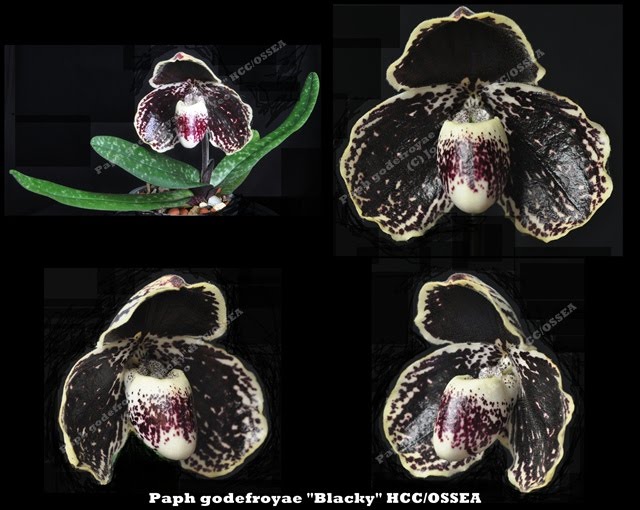
Paph godefroyae Blacky HCC/OSSEA


The plant has been awarded HCC by OSSEA.

Sunday, October 3, 2010

OSSEA - October Table Display

These are some of the plants that were brought to the Monthly OSSEA Table Display Show.

Paph godefroyae - this is a very dark clone. The petals and sepal are almost covered with purple red. The NS for the petals and sepal are 72 and 42 mm respectively across. This is the darkest sibling that was deflasked on June 2008.

Paph godefroyae - different views of the above plant.

Paph godefroyae fma leucochilum 5009-6 - A uncommon red markings over yellow base. It has fat and big pouch.

Paph godefroyae fma leucochilum 140-4 - A nice round shape flower with well marked tessellations over cream base.

Paph Muriel Constance - this is a hybrid between Greyi and bellatulum. The flower has taken more of bellatulum characteristics with round shape and fine purple spottings.

Friday, September 24, 2010

Paph godefroyae Siblings

Paph godefroyae - (Godefroy) Stein 1876:
Here are four Paph godefroyae siblings that were deflasked in June 2008. These 4 siblings flowered within the last 2 months. All the 4 siblings show reddish-purple markings with round shape. One of the siblings has almost 90% of the petals and sepal covered with dark reddish purple colour. The pouch is also well covered by 60% markings instead of spots.

Sibling #3

Sibling #4

Sibling #6 - 90% coloured.

A comparison of the 4 siblings.

Parents of the siblings.

The siblings have the characteristics of both parents. Namely the round shape and the dark reddish-purple markings.

Friday, September 10, 2010

Sept 2010 Flowering Brachys

Above are some of the flowering brachys for this month. It is about the tail end of their flowering season. Normally the flowering season peak between May to August.
In the above photo you will find niveum, concolor, angthong alba, godefroyae and godefroyae fma leucochilum.